FRAYT Driver
- 3.6
- Rating
- 100.00K
- Installs
- Free
- Price

 Analysis by App-foxy
When I look at a driver app, I care less about flashy presentation and more about whether it helps me make the next delivery decision without slowing me down. FRAYT Driver is built for that narrow purpose: it is a free Maps & Navigation app from FRAYT for drivers handling work through the FRAYT service. After spending time with it, I found its main value in keeping the driver’s attention on an assigned delivery workflow rather than making the driver piece together every step from unrelated tools.
That focus makes it different from a normal navigation app. Google Maps, Apple Maps, and similar alternatives are excellent at finding roads, estimating travel, and adapting to traffic. They are not designed around the practical sequence of accepting or managing delivery work, checking the relevant job information, and moving through a driver-focused process. FRAYT Driver is most useful when the delivery itself is the center of the task, not simply the route.
The app is free to use, carries an Everyone age rating, and has reached over one hundred thousand installs. Its average rating is 4.0 from around one thousand ratings, with roughly two hundred written reviews. Those figures suggest a product that has found a real audience while still leaving room for different experiences depending on the driver’s workflow, phone, and expectations.
You May Also Like

 Blood Strike: 2.5 Anniversary
Blood Strike’s Loadouts Turn Every Drop Into a Tactical Gamble
A close look at Blood Strike’s custom loadouts: how fast access to signature weapons reshapes its battle royale rhythm, rewards preparation, and narrows the gap between fights.

 Pandora - Music & Podcasts
Pandora’s Music Is Easy to Start, but Harder to Recover
Pandora’s strength is its low-effort path from a seed to a station. Its weak spot is how much confidence it asks you to place in connection, setup, and quiet recovery.

 8 Ball Pool
 Is Built on Rivalries, Rematches, and Routine
A close look at the rivalries, rematches, shared routines, and unanswered safety questions that turn a quick pool match into a persistent mobile community.

 Samsung Music
’s Quiet Strength Is Playing What You Already Own
Its reach comes less from spectacle than from dependable access to a personal library. That simplicity is both the app’s strongest retention engine and its ceiling.

 AccuWeather: Weather Radar
AccuWeather Review: A Quick, Clear Forecast for Everyday Decisions
For everyday plans, the best forecast is the one you can understand quickly. AccuWeather makes rain timing, radar, and local conditions easy to act on, with a few trade-offs.

 Hill Climb Racing
Why Hill Climb Racing Still Turns Crashes Into One More Run
A tiny car, a bumpy hill and one more upgrade: Hill Climb Racing keeps resurfacing because its simple chaos makes every near-miss feel personal.
More From Our News Desk



Keeping the delivery workflow in one place
I look at this section as a practical question of continuity: can I keep the active delivery and its next step in view without rebuilding the context at every stop? I’ll focus on how a driver-centered workflow can reduce avoidable app-switching, while still leaving room to use a general map when the road or destination calls for a different view. Keeping the job context clear matters most when the day gets busy.
The capability that matters most
The strongest idea behind FRAYT Driver is the connection between delivery work and navigation. Instead of treating a job as a destination that I must manually transfer into another app, the driver experience is organized around the work itself. That distinction sounds small, but it affects how much information I need to remember while moving between pickup and drop-off.
With a conventional map, I usually begin by copying an address, choosing a route, checking whether the destination looks correct, and then returning to another screen for delivery details. Every switch creates a chance to select the wrong address or lose track of which stop I am handling. A purpose-built driver app can reduce that mental juggling by making the assigned delivery the starting point.
I would not describe this as a replacement for every navigation tool. Dedicated map apps generally offer broader map controls and a more mature view of roads, landmarks, and traffic. FRAYT Driver’s advantage is narrower and more practical: it gives the delivery context priority. For someone who drives only occasional personal trips, that focus may feel unnecessary. For someone completing FRAYT work, it is the reason to install it.
There is also a useful separation between personal navigation and work navigation. Keeping delivery activity inside a driver-specific app helps me avoid mixing a customer stop with a private errand or a saved home address. That is not a dramatic feature on its own, but it becomes valuable during a busy shift when several destinations are competing for attention.
What I would prepare before driving
The best results come from treating the app as part of a pre-drive routine rather than opening it only after the vehicle is moving. I would check the current job information while parked, confirm that the pickup and destination make sense, and make sure the phone is ready for a full trip. This is especially important when the delivery involves an unfamiliar commercial area, a large building, or a destination where the final approach can be confusing.
I also recommend checking the phone’s battery and mounting position before accepting a long period of driving. A driver app is only helpful if I can read it safely and keep the device powered. The app does not remove the ordinary responsibilities of driving: I still need to follow road signs, use safe stopping points, and avoid interacting with the screen while the vehicle is moving.
A small but important habit is to compare the displayed destination with the physical delivery instructions before leaving the pickup point. Map entries can identify a property without explaining which entrance, dock, or receiving area is appropriate. FRAYT Driver can organize the work, but I should still use judgment when the road endpoint does not match the practical place where a delivery can be completed.
How it feels in a normal delivery
Imagine I am starting a weekday delivery after loading the vehicle. I open the driver app while parked, review the job, and use the delivery information as the reference for the trip. Rather than writing the address on paper or moving between several unrelated apps, I keep the work context in front of me and use navigation as part of that process.
On the way to the pickup, the benefit is mostly organizational. I know which task I am working on and why the destination matters. After collecting the items, the same job remains the reference point for the next leg. That continuity is more useful than a map alone because it reduces the chance that I will navigate to a place correctly but lose track of the delivery details attached to it.
At the destination, I would slow down and treat the final approach as a separate decision. A route can end at a general address while the actual handoff requires a specific entrance or loading area. I found that the app is best used for maintaining the delivery thread, while local signs, building instructions, and common sense handle the last few metres.
This is one of the app’s less obvious strengths: it can reduce the number of small administrative decisions around a trip. It does not make a difficult building easy, and it does not replace careful route checking, but it gives the driver a consistent work-oriented place to return to after each driving segment.
The scenario where it makes the biggest difference
FRAYT Driver makes the most sense for a driver who regularly handles FRAYT deliveries and wants a dedicated work tool instead of relying entirely on a general map. The clearest scenario is a shift with several time-sensitive tasks, unfamiliar addresses, and little tolerance for confusion between pickup and drop-off information.
In that situation, the cost of switching between a marketplace or dispatch screen, a map, notes, and phone calls can build quickly. Even if each switch takes only a moment, the driver has to repeatedly re-establish context. A dedicated driver app cannot solve every coordination problem, but it can make the delivery assignment the anchor for the trip.
It is also a reasonable fit for drivers who prefer a clean separation between work and personal apps. I would rather not keep customer addresses scattered through recent searches or personal navigation history. A work-specific tool gives the shift a clearer boundary and makes it easier to think in terms of active deliveries rather than a collection of unrelated map pins.
Another good use case is a driver who is comfortable with basic navigation but does not want to build a manual process for every job. The app’s value is not that it teaches someone how to drive. Its value is that it supports a delivery-centered routine, which can be easier to maintain than copying information from one service into another.
Where the trade-offs appear
The focused design is also the main limitation. If I want detailed trip planning for personal travel, broad exploration, public transit information, or a highly customizable map experience, I would choose a general navigation app instead. FRAYT Driver is not the tool I would open to plan a holiday route or compare several unrelated destinations.
Drivers should also avoid assuming that a work-focused screen can answer every question about a property. Delivery locations often have practical complications that are not visible in a route: restricted access, confusing entrances, loading rules, or a destination pin placed at the public-facing address. The app helps organize the job, but it does not eliminate the need to inspect the surroundings and follow site instructions.
There is a trade-off in keeping the experience centered on FRAYT work. That specialization is helpful when I am actively handling a FRAYT delivery, but it offers little value when I am not. Someone who drives for several unrelated services may still need other apps for those jobs. In that case, the advantage of a dedicated workflow has to be weighed against having multiple driver tools on the same phone.
I would also be cautious about judging the app only by its rating. A 4.0 average is respectable, but driver apps are unusually sensitive to context. A person with a modern phone, reliable connectivity, and straightforward delivery locations may have a smoother experience than someone working in areas with weak service or complicated addresses. The rating gives a useful general impression, not a guarantee that every shift will feel effortless.
Practical habits that improve the experience
My first tip is to review the next action while stopped, not while approaching an intersection or searching for a driveway. This sounds obvious, yet delivery work creates pressure to move quickly. A short parked check is safer and usually more efficient than correcting a wrong turn after the fact.
My second tip is to use the app as the source of delivery context and a map as a supporting view when necessary. That division of labor avoids expecting one tool to do everything. FRAYT Driver keeps the work organized; a familiar map can help me understand a complicated road layout or locate a nearby landmark. The important point is to verify that both views refer to the same stop before driving.
My third tip is to pause at the pickup point and reconcile the physical items with the active delivery before leaving. In a multi-stop day, the most expensive mistake may not be a missed turn but taking the correct route with the wrong delivery. A deliberate check of the job context, packages, and destination is a better use of a few parked moments than relying on memory.
Finally, I would keep the phone interface as simple as possible during a shift. Notifications from unrelated apps, crowded screens, and low battery all compete with the delivery task. The more focused the phone setup, the more likely the driver is to benefit from FRAYT Driver’s focused design rather than turning it into another source of distraction.
Who should use it, and who should skip it
I would recommend FRAYT Driver first to active FRAYT drivers who want their delivery work and navigation to feel connected. It is particularly suitable for people who dislike copying addresses manually, who handle unfamiliar destinations, or who want a clear boundary between professional driving and personal navigation.
It may also suit a new delivery driver who needs a consistent routine. The app will not replace experience with loading, parking, customer communication, or finding the correct entrance, but it can provide a more relevant starting point than a blank map. I would still encourage a new driver to learn the surrounding navigation tools rather than depending on one app for every situation.
I would skip it if I am looking for a general-purpose navigation replacement, a travel planner, or a tool for work unrelated to FRAYT. I would also hesitate if my main need is advanced route optimization across many independent stops. A delivery-centered app can organize the active work, but that is not the same as giving me every planning control available in a specialist logistics system.
Because the app is free and rated for Everyone, the barrier to trying it is low. Still, free does not mean universally useful. The right question is whether I regularly need the FRAYT driver workflow. If the answer is yes, the focused design has a clear practical purpose. If the answer is no, a familiar map app will probably be more useful for everyday travel.
My conclusion after using the driver-focused approach
FRAYT Driver succeeds by staying close to one job: helping FRAYT drivers manage delivery work while they move from one place to another. I appreciate that it does not need to pretend to be a complete replacement for every mapping or logistics tool. Its value comes from reducing the distance between the assignment and the route, which can make a busy delivery feel easier to follow.
The current version is 3.13.1, and the app was released on June 20, 2023. It is developed by FRAYT and remains free to install. Those details make it straightforward to try, but my recommendation still depends on the user’s role. The app is not a universal navigation solution; it is a specialized companion for the company’s drivers.
My honest recommendation is to use FRAYT Driver when delivery context matters more than broad map features. Pair it with safe driving habits and, when needed, a general navigation app for extra road detail. For a regular FRAYT driver, that combination can remove avoidable friction from the shift. For everyone else, the specialization is likely to feel more limiting than helpful.
FAQs for FRAYT Driver
01What is FRAYT Driver and how does it work?
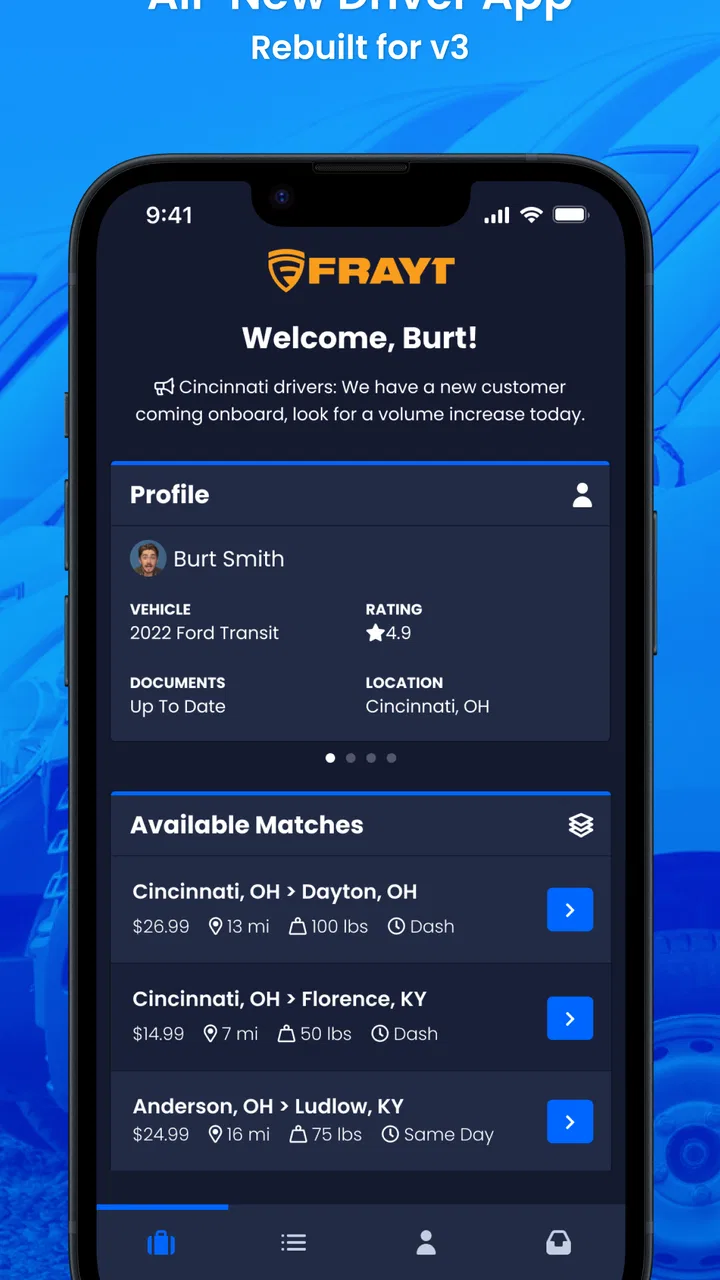
FRAYT Driver is a delivery app designed for drivers looking to earn money by completing delivery tasks. Once registered, drivers receive notifications about available delivery jobs. They can accept tasks based on their availability and preferred routes, using the app's GPS for efficient navigation. Payments are processed through the app, ensuring a streamlined experience.
02How do I sign up and become a driver on FRAYT Driver?
To become a driver, download the FRAYT Driver app from the App Store or Google Play. Complete the registration process by providing your personal information, vehicle details, and necessary documentation. After verification, you can start accepting delivery jobs. The app requires a valid driver's license and a reliable vehicle.
03What types of deliveries can I expect with FRAYT Driver?
FRAYT Driver offers a variety of delivery types, including small packages, furniture, and large items. Deliveries can range from local, same-day requests to scheduled, long-distance jobs. Drivers have the flexibility to choose deliveries based on size, distance, and payout, allowing them to tailor their workload according to their preferences.
04How does FRAYT Driver ensure my safety and security?
FRAYT Driver prioritizes safety by implementing a thorough verification process for both drivers and customers. The app includes features such as GPS tracking, customer ratings, and support services. In case of emergencies or disputes, drivers can contact customer support for assistance, ensuring a secure work environment.
05What are the earnings and payment structure for FRAYT Driver?
Drivers earn money based on the type and distance of each delivery. The app provides a clear breakdown of earnings for each job, including base pay and potential bonuses. Payments are processed weekly through direct deposit, offering a reliable and consistent payment schedule for drivers.
Pros
- User-friendly interface for easy navigation.
- Real-time updates on delivery statuses.
- Flexible scheduling for drivers.
- In-app customer support is responsive.
- Detailed earnings reports accessible.
Cons
- Limited availability in smaller cities.
- High competition among drivers.
- Requires constant internet connection.
- Occasional app crashes reported.
- Some features need frequent updates.

FRAYT Driver
Gallery